
Why Is Testing Your Pool Water So Important?
There’s nothing quite as refreshing as taking a dip in your own swimming pool on a warm summer day. But nothing ruins the fun faster than cloudy water, stinging eyes, or an unpleasant skin rash. The secret to a crystal-clear and safe pool? A perfectly balanced water chemistry. The good news? You don’t need to be a chemist to check whether your water is safe. In this blog, we’ll walk you through exactly how to test it yourself, and why poolblue.store is your go-to partner for all your pool maintenance needs.
Why Is Testing Your Pool Water So Important?
Your pool water is a delicate ecosystem. An imbalance can lead to:
Health risks: Too little chlorine means bacteria and algae can thrive, leading to skin irritations, red eyes, and even illnesses. Too much chlorine, on the other hand, isn’t pleasant for your skin or respiratory system either.
Damage to your pool equipment: Water that is too acidic (low pH) or too alkaline (high pH) can corrode your pool pump, filter, and even damage your pool liner or tiles.
Reduced chlorine effectiveness: An incorrect pH level prevents chlorine from doing its job effectively, meaning you end up using more products than necessary—without getting the results you want.
How to Test Your Pool Water Yourself
You can test your pool water in several ways. Here are the most popular options, ranked from simple to high-precision.
1. Test Strips: The Quick & Easy Choice
Test strips are by far the most commonly used method for home pool owners. They are simple, fast, and affordable.
How it works: Dip a strip into your pool water for a few seconds, shake off the excess, and compare the colours on the strip to the colour chart on the packaging.
Advantages: Perfect for a weekly check-up. Within seconds, you’ll get a good overview of the most critical values like free chlorine, pH, and total alkalinity.
Keep in mind: Colour interpretation can be somewhat subjective, as shades can sometimes be tricky to distinguish. Always store your strips in a cool, dry place away from direct sunlight.
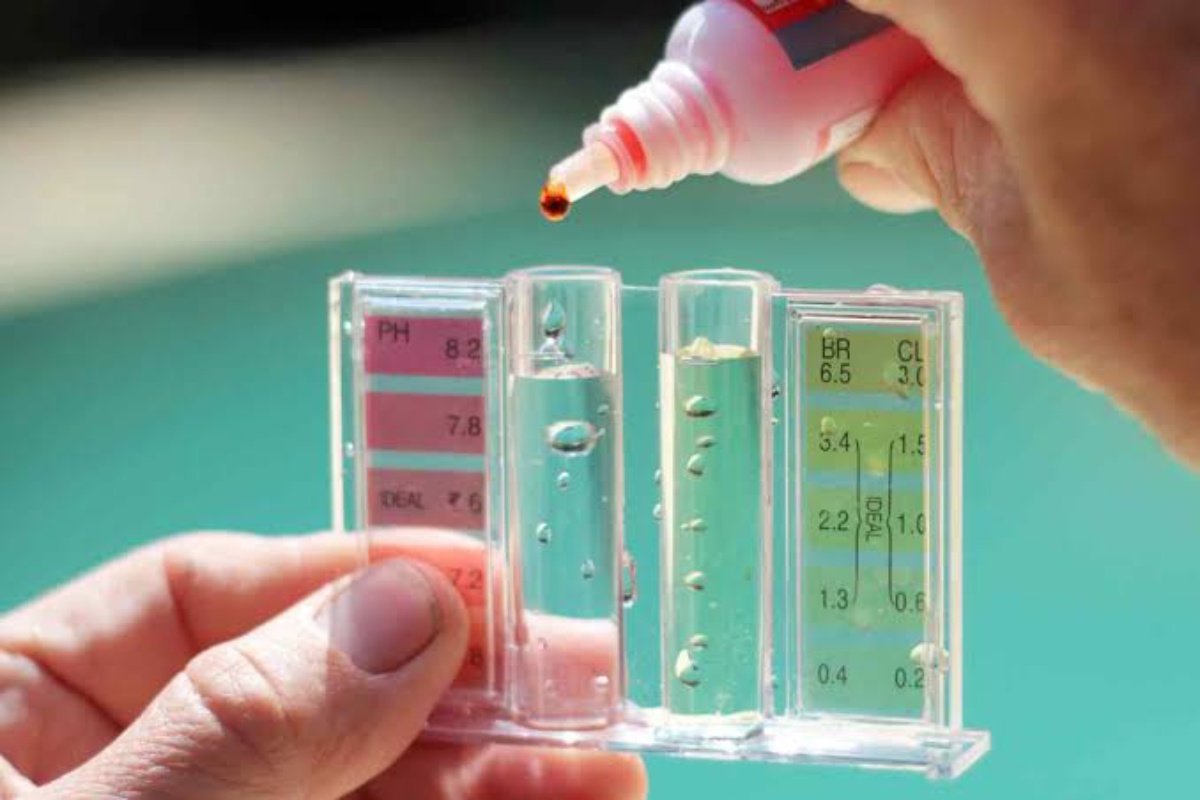
2. Drop Tests (Reagent Kits): For the DIY Enthusiast Who Wants Precision
A drop test kit works with liquid reagents or tablets. You add a specified number of drops to a water sample until the colour changes.
How it works: Fill a small tube with pool water, add a reagent, and count the number of drops needed to trigger a colour change. This gives you a more precise numerical value.
Advantages: This method is more accurate than test strips and is ideal for those who find colour-matching on strips challenging.
Keep in mind: It takes a little more time and requires careful counting of drops for an accurate reading.
3. Digital Testers: The Ultimate in Precision
For the serious pool owner, digital testers—such as photometers—offer the highest level of accuracy. These devices give you an exact, numerical readout and eliminate the guesswork of colour comparison.
How it works: Take a water sample, add a reagent, and place the sample in the meter. The device digitally displays the exact value.
Advantages: They are the most accurate and user-friendly option available.
Keep in mind: These devices are typically more expensive to purchase upfront.
What Exactly Should You Test? The Key Parameters
When you test your water, you're checking a few critical parameters. The ideal ranges are:
Parameter Ideal Value Why It Matters
pH Level Between 7.2 and 7.6 Too low? The water is acidic and can corrode your pool equipment. Too high? Chlorine becomes ineffective and scale can form.
Free Chlorine Between 1.0 and 3.0 ppm This is your primary sanitiser. It kills bacteria and prevents algae growth.
Total Alkalinity (TA) Between 80 and 120 ppm This acts as a 'buffer' for your water, helping to keep the pH level stable.
Cyanuric Acid Between 30 and 50 ppm This is a stabiliser that protects your chlorine from being destroyed by the sun's UV rays.
How Often Should You Test?
A good rule of thumb is to test your water at least 1 to 2 times per week during the swimming season. Test more frequently if you have heavy bather loads, after heavy rainfall, or during extended heatwaves. Always test at the same time of day and before adding any chemicals for the most reliable results.
Your Ideal Partner: Poolblue.store
Now you know how to test, but what do you do when the readings are off? That’s when it’s time to take action with the right products. And that’s where poolblue.store comes in.
At poolblue.store, you’ll find everything you need to bring your pool water back into perfect balance and keep it that way. We offer:
A comprehensive range of testing materials: From handy test strips to accurate drop test kits and digital options. Find the method that works best for you.
All the essential maintenance chemicals: Whether you need to raise or lower your pH, perform a chlorine shock, or adjust your stabiliser, we’ve got you covered. Shop everything from pH-plus, pH-minus, chlorine tablets, to shock treatments with ease.
Expert advice: Unsure about your test results or which products to use? Our experienced team is always ready to help.
Conclusion
Testing your pool water isn’t difficult, and it’s the only way to be absolutely certain that your water is safe, comfortable, and enjoyable for swimming. Whether you prefer the speed of test strips or the precision of a digital meter, make it a regular habit. And whenever your water falls out of balance, you’ll know exactly where to find the right solutions.
Visit poolblue.store today and enjoy peace of mind with a perfectly clear, safe, and inviting pool all season long