
Saltwater Pool Chemistry: What Every Homeowner Should Know
How Does a Saltwater Pool Actually Work?
Saltwater pools have become incredibly popular in recent years—and for good reason. They offer a more gentle swimming experience, with less harsh chemical odours and softer-feeling water. But here’s the truth that surprises many new owners: a saltwater pool is still a chlorine pool. The difference lies in how the chlorine is produced. Understanding the unique chemistry of a saltwater system is essential to keeping your water clean, safe, and equipment running smoothly. In this guide, we’ll break down everything you need to know—and show you why poolblue.store has everything you need to maintain it with ease.
How Does a Saltwater Pool Actually Work?
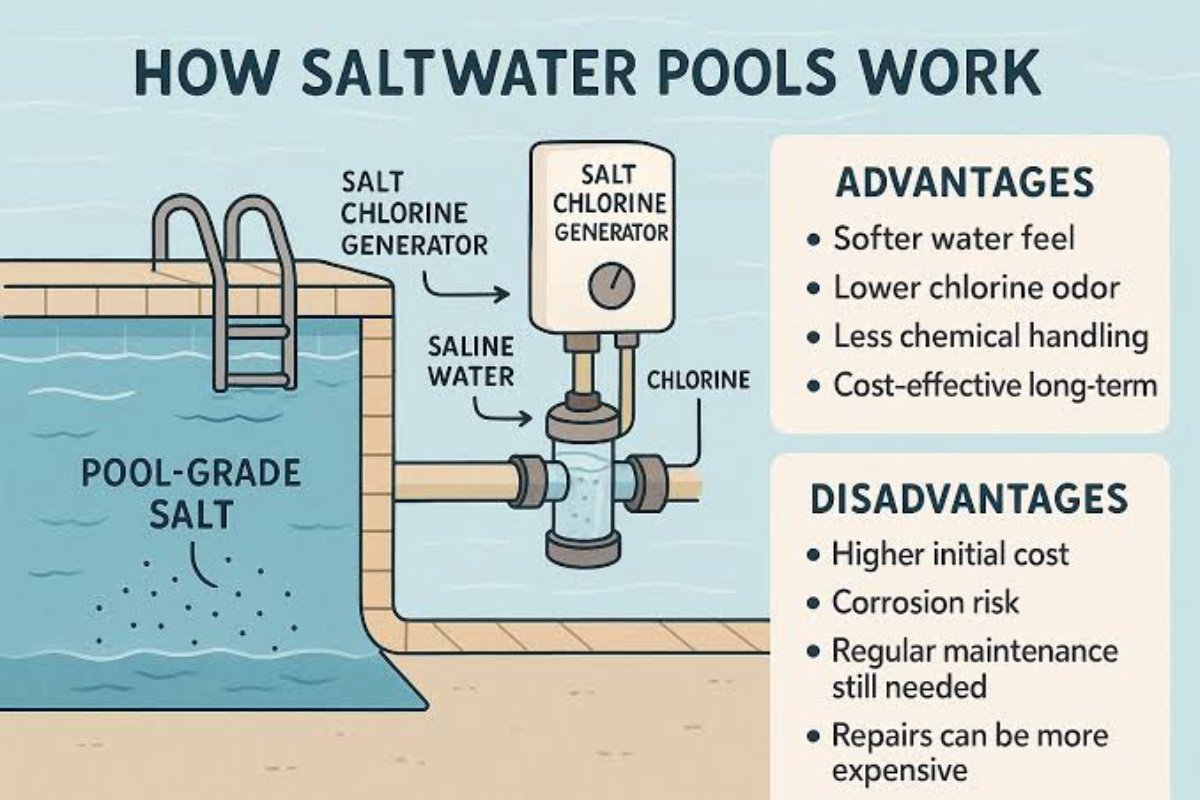
Instead of adding chlorine directly, a saltwater pool uses a salt chlorine generator (also called a chlorinator or cell). This device uses electrolysis to convert dissolved salt (sodium chloride) into hypochlorous acid—the same active sanitizer found in traditional chlorine pools.
In simple terms:
You add salt to the water (typically around 2,700–3,400 ppm).
The salt cell generates chlorine continuously.
After sanitizing, the chlorine reverts to salt, and the cycle repeats.
This self-regenerating loop means you don’t need to buy, store, or handle as many harsh chemical products. But it doesn't mean you can ignore water testing—quite the opposite.
The Unique Chemistry Challenges of Saltwater Pools
While saltwater systems are more forgiving on skin and eyes, they come with their own set of chemical considerations. Here are the critical factors every saltwater pool owner must monitor.
1. Salt Level (2,700 – 3,400 ppm)
This is the foundation. Too little salt, and your chlorinator won’t produce enough chlorine. Too much, and you risk corroding metal components like ladders, rails, and even your pool heater.
Test regularly with dedicated salt test strips or a digital salinity meter.
Pro tip: Rainwater, backwashing, and splashing will dilute salt over time, so top-ups are often needed after heavy rainfall.
2. Free Chlorine (1.0 – 3.0 ppm)
Even though your generator produces chlorine continuously, you still need to test for free chlorine. Demand can spike after heavy bather loads, hot sunny days, or algae blooms.
If levels drop too low, you may need to supplement with a manual chlorine shock.
If levels are too high, reduce the output on your chlorinator or run your pump for fewer hours.
3. pH Level (7.2 – 7.6)
This is arguably even more critical in a saltwater pool. Salt chlorine generators naturally cause pH to drift upward over time because the electrolysis process produces hydrogen gas and sodium hydroxide (a base).
Check your pH at least 2–3 times per week.
You’ll likely need pH-minus (acid) more frequently than in a traditional pool.
Ignoring pH in a saltwater pool leads to scale formation on your salt cell, reducing its lifespan and efficiency.
4. Total Alkalinity (80 – 120 ppm)
Alkalinity acts as a buffer for pH. In saltwater pools, maintaining the right alkalinity helps slow down that constant pH rise. Keep it in range to reduce the amount of acid you need to add.
5. Calcium Hardness (200 – 400 ppm)
Saltwater can be corrosive to plaster and grout if calcium levels are too low. Conversely, if calcium is too high, you’ll see white scaling on your salt cell and pool surfaces.
Low calcium? Add calcium increaser.
High calcium? Partially drain and dilute with fresh water—there’s no chemical to lower it directly.
6. Stabiliser (Cyanuric Acid – 30 – 50 ppm)
Just like a traditional pool, your salt-generated chlorine needs protection from the sun. Without stabiliser, UV rays can destroy up to 90% of your free chlorine within a few hours.
Outdoor pools: Maintain 30–50 ppm.
Indoor pools: Stabiliser is rarely needed.
The Hidden Enemy: Scale and Corrosion
These two issues are the biggest threats to saltwater pool equipment.
Problem Cause Solution
Scale (white crust) High pH, high calcium hardness, or high salt levels. Use a scale inhibitor. Clean your salt cell regularly with a mild acid wash (or use a dedicated cell cleaner).
Corrosion Low pH, low alkalinity, or stray electrical currents (bonding issues). Keep pH and alkalinity balanced. Check your pool's bonding and grounding.
Regular testing and preventative maintenance are far cheaper than replacing a damaged salt cell or pool heater.
Testing Your Saltwater Pool: The Right Way
Testing a saltwater pool requires a slightly broader toolkit than a traditional pool. You need to monitor:
Sanitizer (chlorine)
pH and alkalinity
Salt concentration
Calcium hardness
Stabiliser
You can use:
Test strips – quick and convenient, but make sure they're specifically designed for saltwater pools (including a salt test pad).
Liquid test kits – more accurate for chlorine and pH.
Digital salt meters – for precise salinity readings.
Professional lab tests – once or twice a season for a full picture.
Common Saltwater Pool Myths Debunked
Myth: "Saltwater pools have no chlorine."
Fact: They produce chlorine continuously—it’s just generated from salt rather than added directly.
Myth: "Saltwater pools require no maintenance."
Fact: They require different maintenance. You still test, balance, and clean—sometimes even more frequently.
Myth: "Saltwater is completely safe for all pool materials."
Fact: Salt is corrosive to certain metals and soft stones. Always check manufacturer recommendations for your specific pool finish.
Why Poolblue.store Is Your Saltwater Pool Partner
At poolblue.store, we understand that saltwater pools are a fantastic investment—but only if you stay on top of their unique chemistry. That’s why we stock everything the modern saltwater pool owner needs:
Specialised saltwater test strips that measure chlorine, pH, alkalinity, and salt levels in one go.
pH-minus (acid) – because saltwater pools tend to drift alkaline.
Salt cell cleaners to prevent scaling and extend the life of your chlorinator.
Calcium hardness increaser and stabiliser (cyanuric acid) for complete water balance.
Non-chlorine shocks and chlorine-based shocks to boost sanitisation when needed.
High-purity pool salt – because not all salt is created equal. We stock salt that dissolves quickly and leaves minimal residue.
Plus, our team knows saltwater chemistry inside and out. Whether you're troubleshooting a stubborn pH rise or wondering why your chlorinator isn't producing, we’re just a click away with expert advice.
Final Thoughts
A saltwater pool offers a luxurious, low-odour swimming experience that many homeowners prefer. But it's not a "set it and forget it" system. Success comes down to understanding the chemistry, testing regularly, and acting quickly when values drift out of range.
With the right knowledge and the right products from poolblue.store, you can enjoy sparkling, safe, and comfortable saltwater all season long—without the headache.
Ready to take control of your saltwater pool? Visit poolblue.store today and shop our full range of test kits, chemicals, and maintenance essentials. Your perfect pool is closer than you think.